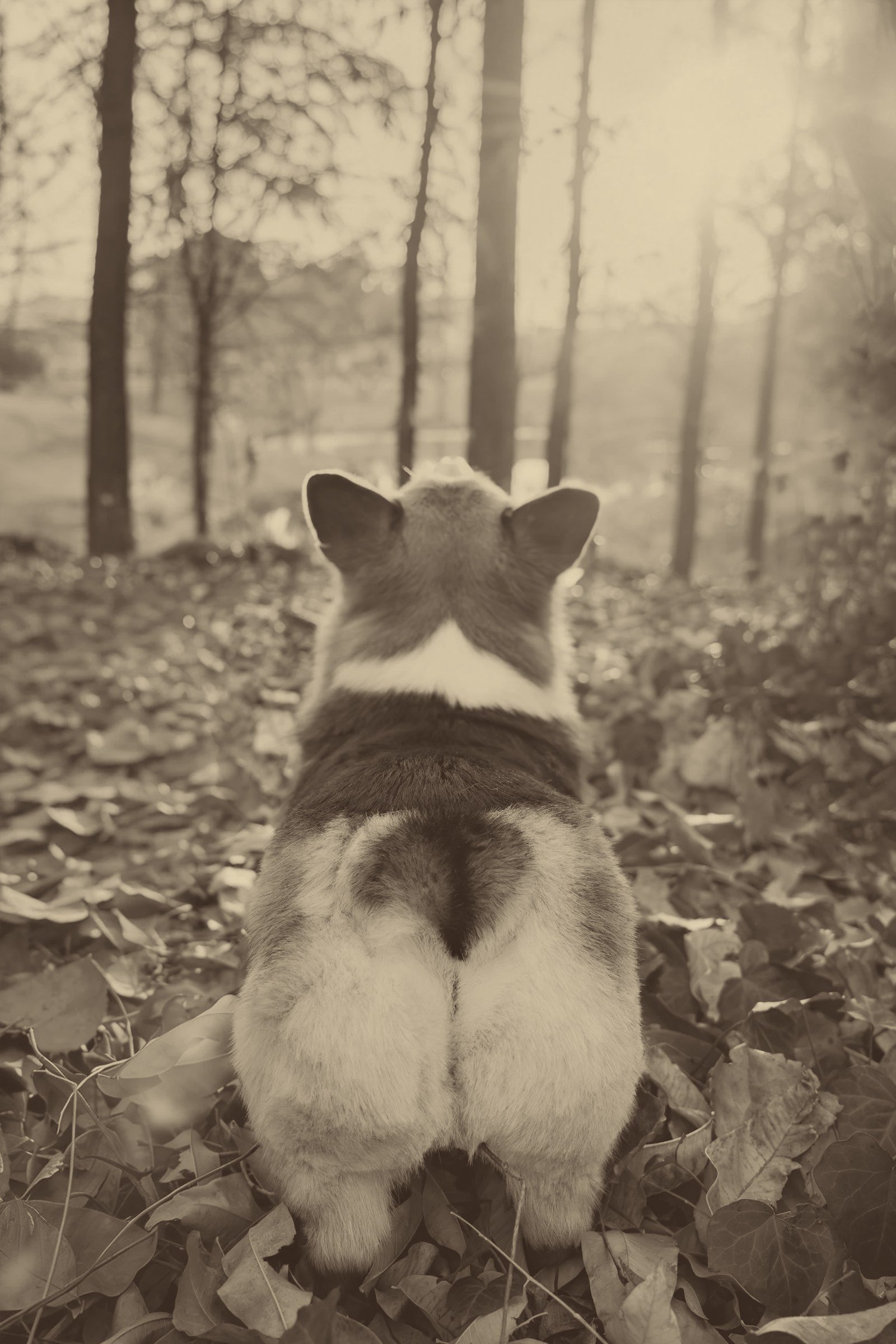
What a dog who has never once accused me of anything taught me about surviving a British winter, resisting an economy built on making you feel like you’re missing something, and staying curious enough to keep wondering.
A Bad Autumn
When the clocks changed in October, my mental health deteriorated rapidly. I wish they’d abolish daylight saving time; its effects are significant, especially for those of us already vulnerable. The prolonged darkness and persistent cold felt insurmountable.
Despite the deepening gloom, I persevered for months. During that time, I numbed myself with food, alcohol, and cigarettes — unsurprisingly, that provided no relief. My mind raced with memories and worries. I expect better from people. I expect more. I expect better from myself. As the days darkened, hope blurred into delusion.
That’s when I pulled the plug on social media, needing the internet’s persistent buzz to disappear. In the quiet that followed, I learned that sometimes it’s better to accept people and circumstances for what they are, not what I wanted them to be. A quote I kept returning to: “Accept it. Change it. Leave it.” I’d spent two decades depleting my energy trying to do the first of those to people and situations I could only ever have done the other two with.
If I wanted real change, it had to begin with my mindset, not with fried food, wine, cigarettes and Facebook in the background. As winter wore on, I learned to sit with a past I couldn’t change. It was isolating and difficult. I longed for connection but felt grateful, every day, for my assistance dog, Radha.
Then, gradually: daily meditation. A few healthier habits. Small changes, brighter days. Just before the spring equinox, I realised that staying in a state of wonder is probably the wisest thing any of us can do.
Curiosity Over Conclusion
Long before that winter, I’d learned this from a different angle — through mentalisation-based therapy (MBT), which trains you to understand your own thoughts and feelings, and other people’s, without immediately deciding what they mean. Its core move is what therapists call a stance of “not knowing.” Rather than labelling or accusing, you stay open. Curious. Willing to consider you don’t have the full picture.
When we choose curiosity over conclusion, we stop reducing complicated moments — in other people, and in ourselves — into fixed labels. Life gets less rigid. More expansive. It’s the same move Alice makes in Wonderland when she says “Curiouser and curiouser” — not confusion, but an invitation to step past certainty rather than cling to it.
“Curiosity is the mother of science. Wonder is the mother of spirituality,” Sri Sri Ravi Shankar says, and I think about that often. Curiosity is the doorway. Wonder is what’s on the other side of it.
What the Dog Knows
Here’s what actually taught me that, better than any therapy technique: my dog.
Radha moves through the world with steady curiosity. Never accusatory. Always loyal. If I forget her treat after a walk, she doesn’t decide I’m a bad dog parent, or that I don’t love her. She pauses in the not-knowing instead — nudges the cupboard, tail wagging, as a gentle reminder — and if I miss the signal entirely, she doesn’t withdraw or hold it against me. She lets it go, curls up, rests. When she wakes, she’s still affectionate. Still open. Still connected.
As humans, we tend to do the opposite. Someone doesn’t reply to a text and we decide they’re fake, or that they don’t care, or that we’re not worthy — and we spiral, and give up on ourselves a little. We build a whole story out of a single silence, then treat the story like it was true all along.
Radha doesn’t do that. She just wonders.
Wonder as Resistance
I think that not-knowing is also, quietly, a form of resistance.
I watched David Attenborough’s A Gorilla Story recently and found myself thinking about the strange coexistence of beauty and suffering — these intelligent, deeply social creatures living in a country that has endured unimaginable violence, and somehow life keeps making beauty anyway. I think, too, about a summer afternoon in Victoria Park, when Radha — not even a year old, coming into season for the first time — caught sight of a boy dog she liked, and her whole body came alive: dancing, twirling, cheeky little paw-slaps, glancing back to make sure he was still watching. I wasn’t wondering how quickly we could get on with our walk. I was just filled with wonder, watching something ancient and instinctive take over an animal who’d never been taught any of it.
There’s a reason moments like that stay with us. Psychologists who study awe — wonder’s close relative — have found it does something measurable: it softens our sense of self, slows the heart rate, and makes us more inclined toward generosity and connection (this is roughly what Dacher Keltner and Jonathan Haidt’s research on awe has found, and what a 2015 study by Paul Piff and colleagues found specifically about awe and generosity). Awe interrupts habitual thought patterns and asks us to actually look at what’s in front of us instead of rushing past it — a kind of presence the modern world is constantly trying to steal from us.
We spend so much of our lives focused on conflict, politics, injustice, uncertainty — for good reason. These things matter. Sometimes we have a responsibility to sound the alarm; looking away doesn’t solve anything. But if all we ever consume or create is fear, outrage and despair, we start to believe darkness is all there is. It isn’t. The same world that contains war also contains gorillas raising their young in mist-covered forests. The same world that contains cruelty also contains a dog dancing because she’s fallen in love for the first time. Wisdom isn’t picking one of those. It’s learning to hold both.
I didn’t record that afternoon in Victoria Park. I could have reached for my phone; instead I chose to stay present and let the memory belong to me rather than to a camera roll. I still return to it, and I still feel exactly what I felt then.
That’s the thing about wonder in a world built to compete for your attention through outrage, fear and manufactured lack: it finds value in what’s already here — light falling through a window, the rhythm of a conversation, breath moving in and out of a body. When you’re in a state of wonder, you’re harder to manipulate, because you already feel full. Anxiety runs on the future — every “what if,” every “maybe.” Wonder pulls you back into what’s actually true right now.
Return
Life is short. I want to spend mine in gratitude, spreading whatever love, beauty and joy I can, and leaving things a little better than I found them.
To remain loyal to my higher self, curious rather than certain, in wonder rather than judgment — that’s the practice, as far as I can tell. Not a mood you land on once. A stance you keep choosing to return to, the way Radha does, every single time.
With wonder,
Karmic Rebelle
Disrupt Karma. Restore Dharma.
Leave a Reply